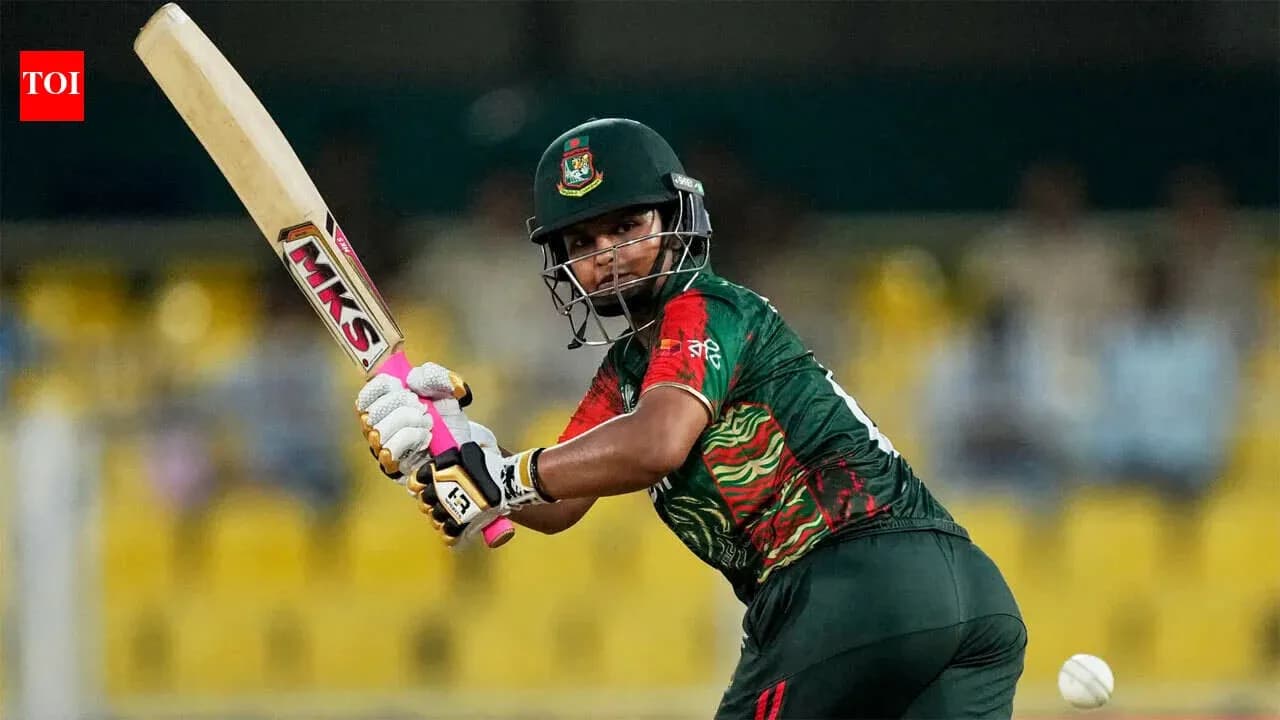
Sobhana Mostary's Journey: From Waiting to Winning in Women's Cricket
Sobhana Mostary still hears the roar.
Not from a packed Dhaka stadium, not from a World Cup knockout, but from a tense afternoon in Kuala Lumpur six years ago, when Bangladesh’s women stunned India and ripped the script of Asian cricket to shreds.
That day still shapes everything.
The shadow – and spark – of 2018
The 2026 Women’s Asia Cup is up and running, and Bangladesh arrive with a familiar tag: dangerous, ambitious, always circling the established giants. For Mostary, though, this tournament is never just another assignment. It is a living reminder of 2018 – the year Bangladesh did the unthinkable and forced their own board, and much of the continent, to look at them differently.
“After 2018, we beat India and won the Asia Cup, so it was a huge change in Bangladesh women's cricket. Everything changed. They started giving us lots of facilities, money, everything. There was a lot of change,” she told TimesofIndia.com ahead of this edition.
Those are not throwaway words. Bangladesh didn’t just win a trophy; they broke a ceiling.
In that 2018 campaign, they didn’t sneak through on net run rate or ride a single upset. They beat India twice. A seven‑wicket win in the group stage set the tone. The final, though, is what lingers: India restricted to 112/9, the chase dragged to the very last ball, Jahanara Alam sprinting back for the winning two as history unfolded in Kuala Lumpur.
The impact back home was instant and visible. The Bangladesh Cricket Board announced a Bangladeshi Taka 2 crore reward for the champions. Facilities improved. Contracts looked different. The women’s team were no longer a footnote.
For Mostary, the mindset shifted too.
“We think this Asia Cup, we fight for the title, because if we beat India, so maybe we own the Asia Cup,” she said.
That is the bar now. Beat India, claim the crown.
A different route to the same dream
To understand why that sentence carries such weight, you have to go back to a village academy and a 10‑year‑old girl who just wanted to play.
Football, badminton, cricket – Sobhana tried them all. Her father eventually took her to a local cricket academy, a small step that turned into a life-altering leap. Six months of training later, she turned up for a trial with the Bangladesh Krira Shiksha Pratisthan (BKSP), the country’s famed sports institute.
She got in.
Selection meant leaving home. As a child, she moved to Dhaka without her parents to chase a sport that, at the time, did not promise much more than a dream and a daily grind. The reward came quickly on paper: an international debut at just 16.
But a cap is not the same as a career.
Mostary spent the next three to three-and-a-half years travelling with the national team, waiting for her name to be read out in the XI, waiting for a chance that never quite arrived often enough.
“It was very difficult. I always travelled with the team, but couldn't play. I just waited and thought that someday the opportunity would come and I could show my strength,” she recalled.
Those are the years that rarely make highlight reels – hotel rooms, nets, warm-ups, then a seat on the bench. Yet they forged the temperament she leans on now.
Growing into the player others predicted
By 2023, the ICC had tagged her as a bright future prospect. Labels like that can weigh heavily, but Mostary treats it as a checkpoint, not a destination.
“I don't think I have fulfilled my dream and that bright future yet, but day by day, I improve,” she said.
That line tells you plenty. There is no rush to declare arrival, no grand claim. Just a steady, stubborn belief that the work will show.
She talks about those early struggles without self-pity.
“I struggled for three or four years, but now I have improved,” she said. Simple, matter-of-fact, like a batter describing a slow outfield.
Idol across the border
Her story carries another twist. The player who lit the fuse of her ambition does not wear green and red.
Her childhood idol is Harmanpreet Kaur.
Mostary remembers the innings that hooked her: the 171* against Australia in the 2017 Women’s World Cup, a knock that shredded a world-class attack and dragged India into the final.
“That match inspired me a lot, I followed her batting, everything how she controls the match, and now the time how she captains. I just followed everything,” she admitted.
The influence runs deep. Mostary studies how Harmanpreet paces an innings, how she absorbs pressure, how she marshals her team. That admiration doesn’t fade when the shirts change on match day.
Facing India, she insists, is not a burden.
“For Bangladeshi fans, playing India is a very good match. They are crazy fans and lots of supporters come to watch. It is a normal match, but normally playing India is very interesting and always very exciting for us,” she said.
The rivalry feeds off passion, not hostility.
Her respect extends to India’s bowling attack as well. Asked which Indian bowler she would most like to face, she did not hesitate: Deepti Sharma.
“Deepti Sharma is always the top bowler in the Indian side, she has played consistently for so many years and improved day by day. I love her bowling,” Mostary said.
A batter who grew up watching Harmanpreet, eager to test herself against Deepti – it is a snapshot of how interconnected the women’s game has become in this region.
Learning from the best
Harmanpreet may be the childhood hero, but Mostary’s wish list stretches beyond the subcontinent.
“I want to practise with Laura Wolvaardt, I really like her batting, and she's also a good human being,” she said.
Wolvaardt’s method – the still head, the clean drives, the ability to bat long – appeals to a young top-order batter trying to round out her game. A session with the South Africa captain is not just about aesthetics; it is about learning how to convert promise into production, how to turn potential into numbers.
Medicine’s loss, cricket’s gain
There was a time when cricket was not even Plan A.
Asked what she might have become had she not chosen this path, Mostary pointed to a very different profession.
“Maybe a doctor, because my mother wanted me to be a doctor,” she said.
That alternate life now feels distant. The teenager who once left home with a kit bag and a thin resume has spent years in national colours, grown up in dressing rooms and on long tours, carried the weight of expectation from a country that has tasted glory and wants more.
Another shot at India, another shot at history
The 2026 Asia Cup presents a new landscape. Bangladesh sit in Group B with Sri Lanka, Indonesia and the UAE. India are parked in Group A alongside Pakistan, Thailand and Hong Kong. Any meeting between the two will have to wait for the knockouts.
That possibility hangs over the tournament like a subplot waiting for its cue.
Bangladesh know what beating India can do. They have lived it. Their board changed. Their status changed. Their own belief changed.
Mostary understands the stakes better than most. She has seen what one final, one last-ball scramble, one upset can trigger in a country still building its women’s cricket culture.
So as Bangladesh begin another Asia Cup run, she carries two timelines in her head: the 16-year-old who sat on the fringes and waited, and the player now ready to shape games against the best in Asia.
If the draw delivers that India-Bangladesh clash once more, the equation in her mind will be brutally simple.
Beat India. Own the Asia Cup.