Sonal Dinusha's Remarkable Performance in India Series
Sonal Dinusha walked into this India series with just three Tests behind him and no hiding place in sight. Four innings, four high‑wire entries, each one a trial by spin on Sri Lankan pitches that can swallow young batters whole.
He didn’t flinch. He flourished.
Across those four innings, Dinusha piled up 420 runs, three of them converted into centuries. Sri Lanka still lost the series, but in the middle of the wreckage, a 23-year-old left-hander announced that he has the temperament – and the method – to live in the heat.
Owning the danger length
On these surfaces, the game against spin lives in that awkward 3‑5m zone. Get stuck there, and you’re trapped on the crease, prodding and groping. Survive it, and suddenly the field opens up.
Most Sri Lankan batters found out where they stood soon enough. Dinusha drew a line and walked towards it.
Against good-length balls from the spinners, he scored 182 runs at an average of 91 and a strike rate of 58.89. The series baseline for that length was 26.42 and 45.36. He didn’t just beat the average; he ripped it up. No batter from either side scored more runs off that band of length. Only Niroshan Dickwella, in a much smaller sample, went quicker.
Even Player of the Series Devdutt Padikkal, with his 69.50 average and 49.82 strike rate overall, lagged behind Dinusha in that specific battleground. When the ball landed where it was supposed to trouble him, Dinusha turned it into his scoring zone.
The secret lay in where he met the ball.
His average interception point against good-length spin was 2.64m from the stumps – the furthest of any batter in the series. Padikkal, often happier hanging back, sat at the opposite end of the spectrum at 2.02m. Dinusha refused to let the ball climb into that indecisive space. He went to it.
Only 43.4% of good-length balls bowled to him were met in the so‑called danger zone between 1.5m and 3.5m from pitching to interception. Among Sri Lankans, no one did better. Across both teams, only Padikkal, Rishabh Pant and Ravindra Jadeja pushed that percentage lower.
Front-foot intent, short-man solutions
The numbers tell you how he played; his size tells you why he had to do it that way.
Shubman Gill, tall and rangy, topped the series for front-foot play against spin, pressing forward to 77.3% of the balls he faced. Dinusha, listed at just five foot six, was next at 73.6%. But while Gill could lean on reach, Dinusha had to manufacture it.
So he moved.
He charged. He swept. He forced the spinners to keep guessing.
He stepped down the pitch to 12% of all deliveries he faced, second only to Pant’s 13.3%. His sweep percentage went even higher: 21.6%, the most of any batter in the series. This wasn’t a garnish; it was the core of his gameplan.
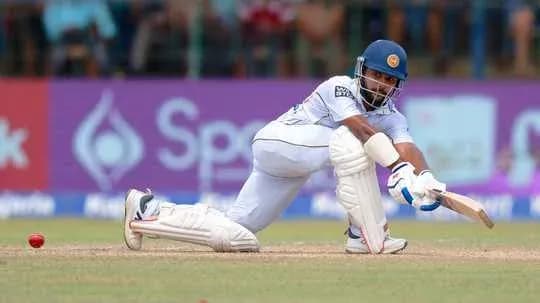
The scale of his commitment to the sweep was startling. Dinusha attempted 120 sweeps – including reverse and slog-sweeps – and scored 173 runs from them. Both marks are now the highest ever recorded for a single series, surpassing Joe Root’s sweeping masterclass in Sri Lanka in 2021. Against all four of India’s frontline spinners, he scored at better than a run a ball when he went to the sweep.
The most unsettling length in the series – the 4‑5m band – produced 27 wickets at 21.14. That’s where batters usually come to grief. Dinusha faced 212 balls in that corridor and walked away with 125 runs for just one dismissal. Again, the method held: 53 sweeps for 87 runs, and 32 balls taken by stepping down the track.
This was not survival. It was control.
Taking on Jadeja, bending the field
Doing that to Ravindra Jadeja, with his skiddy pace and relentless trajectory, carried extra weight. Jadeja lives in that uncomfortable length, hurrying batters, pinning them, forcing them to defend the stumps.
Dinusha went the other way. He attacked the base of Jadeja’s method.
He attempted 34 sweeps against Jadeja alone – more than any batter has ever played against him in a subcontinent series. He also advanced down the track to 36 deliveries from Jadeja, just two fewer than Michael Clarke managed across five innings in India’s 2013 four-Test series.
These were not wild swings. Eighteen of Dinusha’s 30 boundaries against spin came via sweeps or their variants, most of them in front of square on the leg side. He mixed in paddle sweeps, reverse sweeps, and – on four separate occasions – began a new session with a slog sweep to the midwicket boundary.
Those shots did more than decorate the scorecard. They ripped at the fabric of the bowler’s plans. Once a spinner starts worrying about being swept from good length, his entire map shifts. Fielders move. Lengths change. Lines drift.
Dinusha feasted on that uncertainty.
With the field stretched and the length altered, he slipped into a quieter gear. He nudged, pushed and worked the ball into gaps, turning pressure overs into ones and twos, making sure the scoreboard never stalled. The innings, for all the highlight strokes, did not rely on constant boundary-hitting.
Only 4.98% of the balls he faced went to the rope – the second-lowest boundary percentage among specialist batters who faced a substantial volume of deliveries, ahead of only Jadeja. He wasn’t chasing the fence. He was building an innings, brick by brick, over long hours.
Defined by what he refused to play
One final detail underlines the clarity of his thinking.
Across the series, Dinusha did not hit a single boundary through the front-of-square off-side against either pace or spin. The classic cover drive – the shot young batters often fall in love with – never appeared as a scoring blow to the rope.
He cut it out. Completely.
On these pitches, against this attack, he decided that the risk wasn’t worth the reward. He trusted the leg side, trusted the sweep, trusted his feet. He trusted the grind.
Sri Lanka lost the series, but in the middle of India’s superior spin and the home side’s broader struggles, Sonal Dinusha quietly built a blueprint. The question now is not whether his method works under pressure. It’s how far that method can carry him when the stakes climb even higher.