Sophia Dunkley concludes England summer with century and series sweep
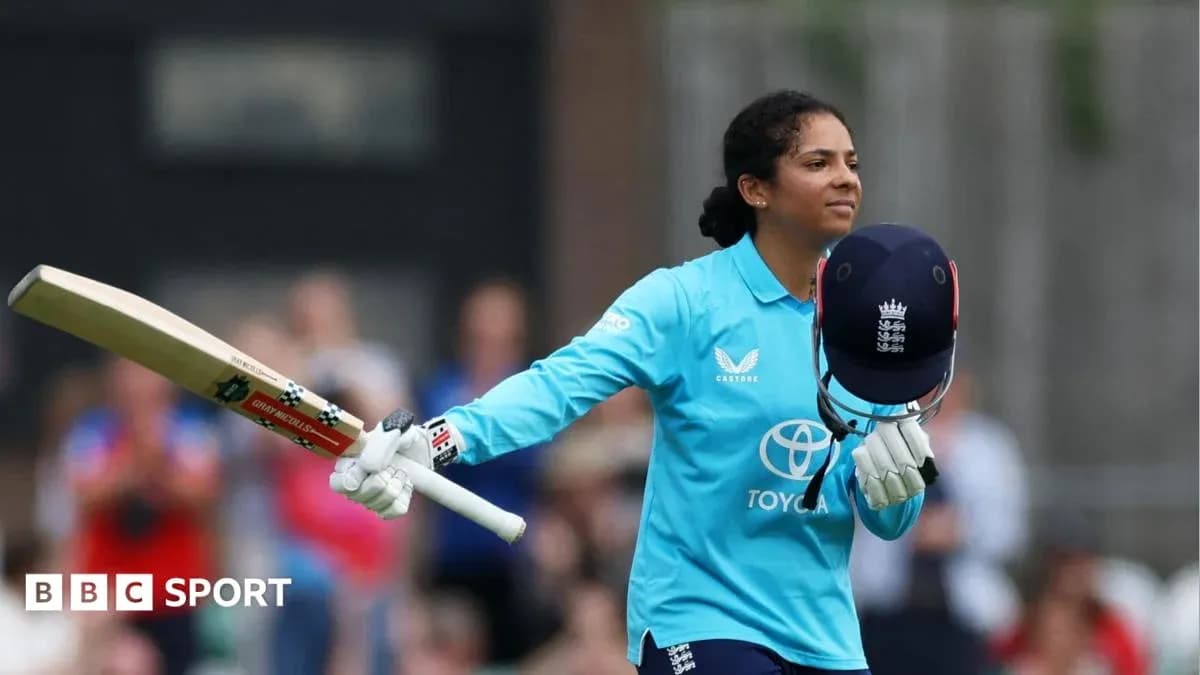
At New Road, under a grey Worcester sky that never quite turned threatening, Sophia Dunkley lit up England’s final day of the international summer.
A run-a-ball 119 from the opener powered England to 291 all out and set up a thumping 114‑run win over Ireland, sealing a 3-0 ODI series sweep for Charlie Dean’s side. It was dominant, occasionally scruffy, and ultimately more than enough.
Dunkley grabs her moment
This has been an odd series for England: key names rested, formats scattered across a disjointed calendar, and the sense of a team trying to answer long-term questions in a short, lopsided contest.
One of those questions sat right at the top of the order. Tammy Beaumont’s retirement had left a vacancy, and Dunkley walked out knowing that chances at this level are suddenly more precious.
She made this one count.
Early on, Maia Bouchier stole much of the strike and much of the tempo. Dunkley ticked along, 50 coming from 63 balls, content to let her partner punch the gaps and keep Ireland’s seamers busy. The pair added 73 for the first wicket, Bouchier continuing her excellent run with a brisk 39 before falling, having again looked set for something bigger.
Once Bouchier departed, Dunkley shifted gears. The next fifty took just 37 balls. Drives flashed through the off side, clips whipped through midwicket. This was not the one-dimensional, leg-side-heavy Dunkley of old. Her scoring almost perfectly split both sides of the wicket, a visible evolution in a player who has spent the summer rebuilding her game.
Ireland tried to unsettle her with the short ball, pushing fielders to the rope and forcing her to hit to sweepers. She absorbed it, picked her moments, and kept England’s innings anchored as partners came and went.
Jodi Grewcock again hinted at her promise with 35 before falling to a sharp caught-and-bowled. Alice Capsey was unfortunate, run out backing up for 10. Yet Dunkley remained, ticking towards three figures and dragging England towards a total that, for a time, looked like it might be monstrous.
Her eventual dismissal – brilliantly taken by Orla Prendergast at deep square leg in the 36th over – did not dull the quality of the innings. It simply exposed how much England had leaned on her.
From launchpad to collapse
At 260-4, England had 300 – and possibly well beyond – at their mercy. The platform was perfect. The outfield quick. Ireland’s bowlers tiring.
Then the innings stalled.
Freya Kemp, who had threatened to cut loose, holed out to long-on for 23. Her wicket cracked the door open for Ireland, and England walked straight through it the wrong way. The last six wickets fell for just 31 runs. Seven balls of the innings went unused.
Dani Gibson, with an ODI-best 41, was the only batter to find any fluency in the closing overs. Around her, single-figure scores piled up as England’s middle and lower order frittered away what could have been a record total.
Cara Murray deserved much of the credit. The leg-spinner finished with 4-56, the pick of Ireland’s attack, and dragged the innings back from the brink of a rout. After Dunkley’s dismissal, England managed only seven boundaries. The grip tightened, the momentum shifted, and what had looked like a 320-plus score shrank into something more human.
It still felt plenty.
On a surface offering just enough and against an Ireland batting line-up that has struggled for tempo all series, 291 loomed large.
Filer and Villiers close it out
Any faint Irish hopes needed a blazing start. They never arrived.
Amy Hunter top-scored with 39 from 58 balls, but her innings told the story of the chase: tidy, stubborn, and ultimately too slow. No Irish batter managed a strike-rate over 100. The required rate crept up, then sprinted away.
England’s bowlers did not need to be spectacular; they just needed to be relentless. Lauren Filer and Mady Villiers provided the cutting edge. Both finished with three wickets, sharing the dismantling of a line-up that never quite looked capable of reeling in the target.
Once the early resistance faded, the chase turned into a slow unravel. Singles replaced boundaries, dot balls mounted, and by the time the lower order arrived, the game was gone. Ireland were bowled out for 177 in 44.2 overs, a margin that accurately reflected the gulf across the series.
Answers amid an awkward calendar
Strip away the scoreline and this has been a curious assignment for England. No Lauren Bell. No Sophie Ecclestone. No Nat Sciver-Brunt. A clutch of fringe players – Grewcock, Tilly Corteen-Coleman and others – asked to step into a format that England barely get to play.
Their next confirmed ODIs are at the Champions Trophy in February. A multi-format series against West Indies and three ODIs against Sri Lanka sit on the schedule for the autumn, but without dates. Their next home ODI? Not until the Ashes next summer.
In that context, every 50-over outing carries extra weight. Every selection call feels a little sharper.
The opening partnership was the glaring issue. Across this series, Dunkley and Bouchier have done what any coaching staff crave: turned opportunity into runs. A century each, authority at the top, and a sense that England may just have stumbled upon their new pairing.
The caveat is obvious. Ireland’s attack is a world away from what awaits against Australia. No one inside the dressing room will pretend this is Ashes preparation. England can only face what the schedule throws at them, and right now, that schedule is far from ideal.
Even so, some pieces have moved into place. Sciver-Brunt will walk straight back in at number three when available. The wicketkeeping question – whether Capsey continues with the gloves or Amy Jones returns – still hangs in the air. But at the top, Dunkley and Bouchier have eased one of Charlotte Edwards’ more persistent headaches.
On a day when the innings frayed at the edges and the calendar still makes little sense, England at least finished their summer with clarity where it matters most: runs on the board, a series whitewash, and an opener who has finally turned promise into something far more tangible.