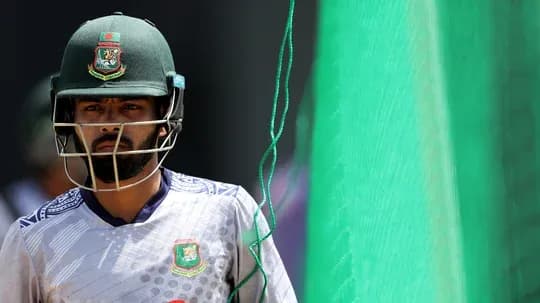
Towhid Hridoy's Historic 350 Runs in Potchefstroom
In Potchefstroom, a familiar South African town that already sits in his personal folklore, Towhid Hridoy quietly walked into a four-day game and left with a record that will follow him for the rest of his career.
Unbeaten. 350 runs. The highest first-class score by a Bangladeshi batter.
This was supposed to be a stopover, not a statement. He had been drafted into the Bangladesh A squad almost out of necessity, flown in with Nurul Hasan, Rishad Hossain and Mohammad Saifuddin after injuries and visa issues thinned the touring party. He was cover, reinforcement, insurance.
He turned into the headline.
From stand-by to centre stage
At the airport in Dhaka, before boarding the flight, Hridoy hardly sounded like a man obsessing over a four-day assignment. The Test series for Bangladesh A was not his main target. He spoke instead about conditions, white-ball plans, and the bigger stage that looms.
“The preparation is very important and as we have a national team tour and the World Cup (ODI), will try to prepare for it,” he told reporters, his eyes already on the upcoming white-ball series against South Africa and the ODI World Cup next year.
Red-ball cricket? That was somewhere in the background, and with good reason.
He had waited more than three years to break into the Test team after his white-ball debut, only to be discarded after a single appearance. Three days of Test cricket in Harare against Zimbabwe, one failure in the second Test, and the door shut almost as quickly as it had opened.
For some, he had been rushed. For others, his technique screamed white-ball specialist. Very few stood up and argued that he deserved a proper run in the longest format.
The selectors had publicly maintained that cracking the national side in any format would guarantee a fair stretch of opportunities. Hridoy’s experience told a different story. No wonder he stopped looking too far ahead when it came to Test ambitions.
A record that cannot be ignored
And yet, here he is. Only the third Bangladeshi batter to reach a triple hundred in first-class cricket. Past Tamim Iqbal’s unbeaten 334. Beyond Raqibul Hasan’s unbeaten 313. Now out on his own with 350 not out, carved against South Africa A in conditions he wanted to “get accustomed to” for white-ball cricket.
He walked in without the weight of red-ball expectations and batted like it. No audition, no looming judgment, no whispered conversations about his Test place swirling in his head. That freedom became his greatest ally.
The pressure finally told – not on him, but on the bowlers. As the innings stretched and the numbers climbed, the narrative around him began to change. What started as a tune-up for limited-overs cricket turned into a powerful reminder that his game has a longer, more patient side.
Yet when the questions came about his red-ball future after the game, he did not bite.
“This is not entirely my call, as a professional player I always want to do well, I have said this on many occasions before, how many matches I will play for the national team will depend on the selectors, if I get the opportunity I will try to do well,” he said.
No demands. No public frustration. Just a quiet acknowledgment that the decision lies elsewhere.
The selectors’ dilemma
They cannot look elsewhere now.
Bangladesh’s next Test series will arrive with Hridoy’s 350 stamped across every selection meeting. Leaving out the man who owns the highest first-class score in the country would take some explaining. Including him is the obvious move. Managing him properly is the real test.
It is no longer just about squeezing his name into a squad list. The bigger question is whether Bangladesh can convince him – and prove to everyone watching – that this time he will be given a genuine run, not a one-match audition followed by the exit door.
Because this innings in Potchefstroom was not played by a man campaigning for selection. It was played by a batter who had, in many ways, stopped worrying about it. That detachment allowed him to express himself, to bat long, to show that his temperament and technique can stretch across formats.
Now the debate returns to the table: is Towhid Hridoy a white-ball star dabbling in red-ball cricket, or a three-format player who never truly got his chance?
The next Test squad Bangladesh names will offer the first real answer.