Varun Aaron: From Fast Bowler to Coach
Varun Aaron wasn’t looking for a job when the phone rang.
Daniel Vettori’s number flashed up, and with it came a turn in a career Aaron thought he’d already closed. He had retired earlier in 2025 at 35, settled into broadcasting, and for the first time in years his body – and his mind – weren’t on a training schedule. Coaching was something he did in passing, not on paper. A tweak here, a tip there, a chat in the Jharkhand dressing room. Nothing that looked like a full-time plan.
Yet the groundwork had been laid long before Vettori called.
Years of injuries had forced Aaron to become his own specialist. He had dissected his action, learned his body’s limits and possibilities, and in the process become a coach without the title. Teammates gravitated to him. Young bowlers asked for his eye on their run-up, their release, their rhythm. He enjoyed it. Not the idea of being “Coach Aaron”, but the quiet satisfaction of seeing someone else bowl better because of a conversation in the nets.
That instinct eventually took shape. The new MRF Pace Foundation High Performance Center was his brainchild – not just a name on a board, but a project he designed and executed. Facility, protocols, programme, even the redevelopment of the ground and gym: Aaron had a hand in all of it, giving back to the academy that had once shaped him. Then came a stint with the Jharkhand State Cricket Association as a bowling consultant, a more formal step into a world he still didn’t quite claim as his own.
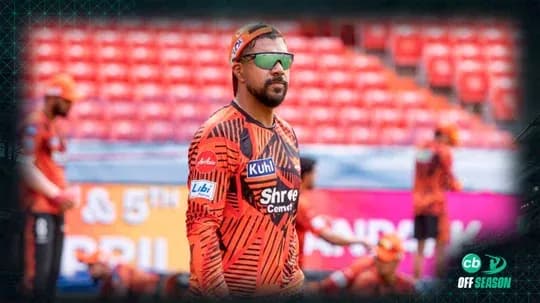
So when Vettori asked if he wanted to coach Sunrisers, it wasn’t part of any grand post-retirement blueprint. It was just the next thing that “happened on its own”, as Aaron puts it. He had wanted to enjoy life after a career repeatedly cut by stress fractures and layoffs. Now enjoyment suddenly meant something else: building a bowling group from scratch in the IPL.
Building Sunrisers’ Pace Pack
For his first season with Sunrisers, Aaron wasn’t just handed a bowling unit and told to polish it. He was invited into the auction room. Given a say. Trusted with a vision.
He went hunting for potential, not polish.
Praful Hinge and Sakib Hussain were two of the quicks he circled early. What drew him in wasn’t what they already were, but what they could become. He saw gaps between performance and possibility and believed he could bridge them.
The payoff came quickly. Against Rajasthan Royals, Hinge and Sakib announced themselves with four-wicket hauls each in their first IPL game. For most viewers, they were overnight sensations. For Aaron, they were the product of weeks of careful work, squeezed into a life that already had a full-time commitment.
Because while he was shaping Sunrisers’ future attack, he was also on commentary duty at the T20 World Cup.
The schedule was absurd. Some days he brought Sakib to Mumbai, called games in the morning and coached in the evening. Other days, it flipped. As the World Cup rolled on and travel intensified, he had to find a way to keep the work going without diluting it. The solution was deeply personal: he sent Hinge and Sakib to the Rao Cricket Academy.
SS Rao had once captained him at Jharkhand. Now, he was the man Aaron trusted to follow instructions to the letter. He laid out a clear programme – “do this, this, this” – and Rao stuck to it. Experience, presence, energy: Rao added all of that on top of Aaron’s blueprint. The combination, Aaron believes, did the young quicks a world of good.
Hinge and Sakib weren’t the only ones on his radar. Shivang Kumar impressed him immensely. Onkar Tarmale, who picked up an injury at the wrong time and slipped under the public eye, was another. In Aaron’s view, Tarmale is a 145 kph bowler in the making, one of several “interesting picks” in a group that quietly carried serious upside.
What made it all easier was the backing he received. The head coach and the team owner didn’t just sign off on his ideas; they empowered him. In his very first year, he almost had a free hand. For a rookie coach in the IPL, that’s rare. It allowed him to be creative, to experiment, to coach with conviction rather than caution. And it made the job fun.
The Gospel of Simple Fast Bowling
If you listen to Aaron talk about fast bowling, one theme cuts through: simplicity.
He believes quick bowling is, at its core, straightforward. Players complicate it. They chase new tricks, new angles, new levers to pull, until the basics get buried. Strip it back, he says, and it comes down to a few principles. Get those right and the game becomes lighter, more enjoyable, more sustainable.
But simple doesn’t mean one-size-fits-all.
Aaron rejects the idea of a set method. Every bowler walks in with a different body, a different mind, a different set of natural gifts. The first job, in his view, is to identify what’s unique about that bowler and turn the volume up on it. Then you look at the shortcomings and work on making the bowler more efficient, not more generic.
Some arrive with beautiful, repeatable actions and can do almost anything they want. Others carry scars – injury histories, awkward mechanics, actions that put pressure on the wrong places. Those are the ones who need more detailed work. They can’t just be dropped into a template.
To Aaron, this is where coaching has to go. Towards the individual. Towards biomechanics, musculature, coordination, mentality – all the things that make one bowler different from the next. The days of treating every fast bowler like a copy of the last one should be over.
He applies the same nuance to performance. He refuses to label spells as simply “good” or “bad” and move on. There has to be a reason. If a bowler does well, the coach’s job is to help them understand exactly why, so they can repeat it. If they struggle, the failure becomes information, not a verdict. Just turning up, bowling, going home, and repeating the cycle without reflection? For Aaron, that leads nowhere.
Speed, Timing and the Limits of the Body
In India, Aaron’s name will always be tied to speed. His rise began with a number on a screen: 153 kph in the 2010/11 Vijay Hazare Trophy final, at a time when true pace was still a rarity in the country.
Young quicks still come to him with one burning question: how do I bowl faster?
His answer isn’t about gym numbers or run-up length. It’s about timing.
He draws a parallel with batting. A batter wants to time their initial movement, stay balanced, keep the head still, and create the space to access the ball. For a bowler, the equivalent is the sequencing of the action before release. Get that timing right, and you unlock your ceiling. You bowl as fast as your body allows, you stay fitter, and you hit your areas more often.
The key line is that last part: “You can only bowl as fast as you can. You can't bowl faster than your body is going to allow.” Aaron knows that better than most.
His own career was a constant tug-of-war between the thrill of speed and the price his back was willing to pay. After his Ranji Trophy debut in 2008/09, three stress fractures followed. Test cricket brought a similar pattern. He debuted in 2011, then spent almost three years waiting for his second Test in 2014 because his back simply wouldn’t cooperate.
Now, as a coach, he lives that same tension again – only this time through other people’s bodies. He has to help them chase pace without breaking themselves in the process, a line he spent much of his playing life walking, and sometimes crossing.
Between the Commentary Box and the Nets
His calendar is a mess. Coaching Sunrisers. Working with young quicks. Broadcasting tournaments around the world. It’s no surprise that when he’s asked how he balances it all, he jokes that his girlfriend would have a sharper answer than he does.
He knows he’s hardly at home. He’s trying to change that, to carve out more time for his family. But he also admits the truth: it’s hectic, and he enjoys it.
The dual role feeds itself. Coaching gives him an intimate view of players – not just what they do, but how they think. He learns their habits under pressure, their go-to deliveries, the fields they like for certain balls. When he steps into the commentary box, that knowledge sharpens his analysis. He isn’t guessing; he’s drawing on first-hand experience.
The traffic runs both ways. Broadcasting keeps him plugged into cricket across formats and competitions. He watches more players, more often, and that constant exposure filters back into his coaching. Trends, tactics, new methods – he sees them in real time and carries those insights into the nets.
For someone who never sat down and said, “I want to be a coach,” Aaron has landed in a role that feels strangely inevitable. His body might have forced him to think deeply about fast bowling. His mind has turned that hard-earned understanding into a second career.
What has surprised him is what it does to him at the end of a day.
Coaching, he’s realised, gives him something playing and broadcasting never quite did. When a session finishes and a bowler walks away having hit every target they set, Aaron feels it. Not on a scoreboard, not in a highlight reel, but in that small, private moment when someone knows they’ve just taken a step forward.
For a man who once measured success in kilometres per hour, that might be the most important number of all.