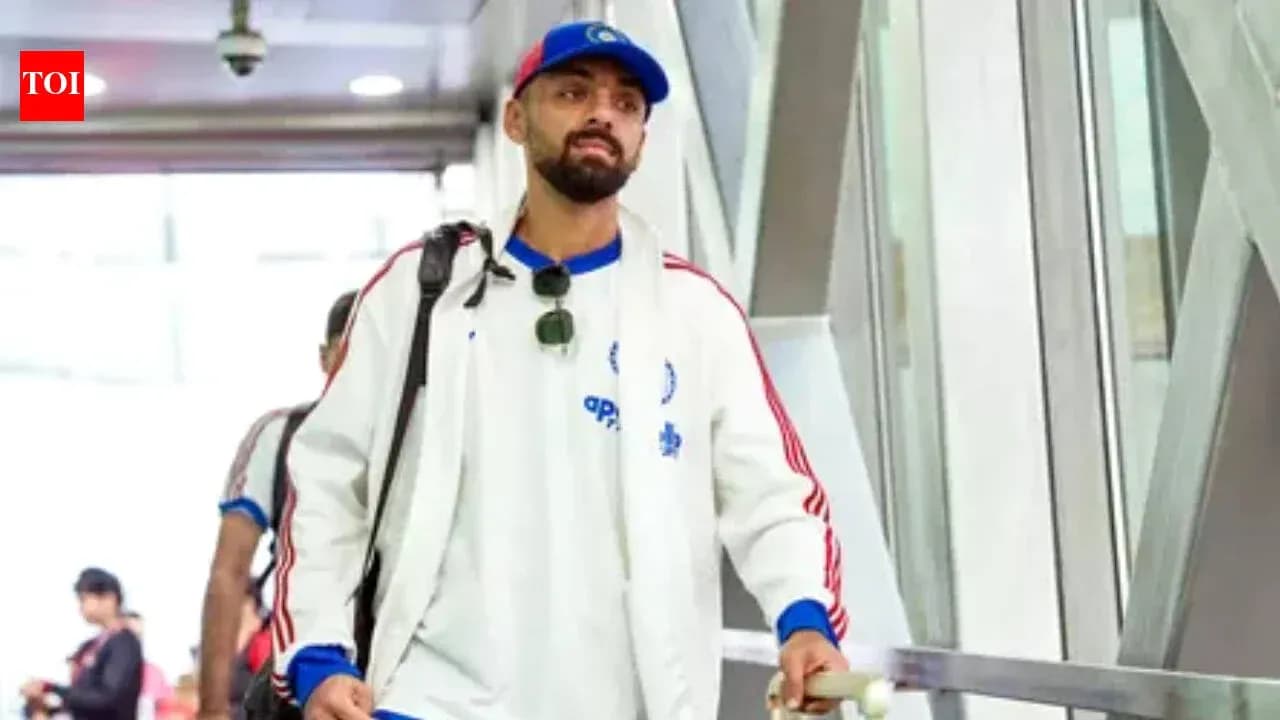
Varun Chakravarthy: The Late Bloomer Ready for His Second Act
For most international cricketers, 35 is a number that nudges you toward the finish line. For Varun Chakravarthy, it feels suspiciously like halfway.
This is the man who debuted for India at 29, then squeezed a T20 World Cup title, an IPL season played through hairline fractures, and his first-ever muscle injury into a breathless 12 months. Anyone else might call it a career-defining year. He calls it the start.
"At this stage of my career, I still feel I'm in my first half of my career because I started cricket very late. So I still feel there's a long way to go," he told TimesofIndia.com in an interaction facilitated by equipment manufacturer ASICS.
You can see why the numbers don’t quite capture him. Joint-highest wicket-taker for India at the T20 World Cup with 14 wickets, a key cog in the IPL despite playing with fractures in his left hand and toe, and then a Grade 2 left hamstring injury that finally forced him to stop. The journey reads like a medical file stapled to a bowling analysis.
Yet the tone with which he speaks is almost disarmingly simple. No grand timelines. No big declarations. Just the next tweak, the next small upgrade.
Learning to Trust a Torn Muscle
Until this summer, Chakravarthy’s pain had a pattern. Impact injuries. Collisions. Freak accidents. Things you could point to on a replay.
"This is actually my first ever muscle injury. So all of my injuries have been impact injuries and other accidents that have happened on field," he said. A torn hamstring was something else entirely — invisible, internal, and, for a spinner who lives on rhythm, deeply unsettling.
The BCCI Centre of Excellence in Bengaluru became his second home. Long days, repetitive drills, the slow rebuild of both body and belief.
"The expertise at CoE helped me and people helped me to gain my confidence. Every person working there helped me," he explained. "Definitely, I spent a lot of time there and did a lot of running and did a lot of strength training, which helped me."
For a bowler like Chakravarthy, the green light from the physio is only half the battle. The rest is psychological. Can you load up off that leg again? Can you pivot without flinching? Can you bowl the ball you see in your mind without worrying about what’s happening in your hamstring?
"Yeah, it will take some time to gain confidence. But once you gain confidence, you just start becoming more expressive and that's how it is," he said.
That word — expressive — is telling. His variations, his angles, the subtle changes in pace: they all rely on a body he trusts. An injury break, then, is not just rehab. For him, it’s also a workshop.
"When you're away, you can start sharpening your skills. You can upskill yourself, which you don't get much time to do when you're playing continuously," he said. Where some see weeks lost, he sees space to tinker.
Now fully recovered from the hamstring strain suffered during the England T20I series, he returns to a calendar that barely pauses for breath: three T20Is against Afghanistan, a one-off international against Japan, and then the Asian Games in Aichi-Nagoya, where India, as defending champions, walk straight into the quarterfinals.
He wouldn’t have it any other way.
The Spinner Who Starts From the Shoes Up
Ask most people what makes a mystery spinner tick and you’ll hear about wrists, fingers, and release points. Chakravarthy starts lower. Much lower.
"For a bowler, shoes are the biggest equipment they can have. Batters, they have many other equipments, but for a bowler, it's the shoes only," he said.
His association with ASICS is now official — the deal was signed in January 2026 — but the relationship started earlier, around 2022, when he quietly shifted to their footwear. The way he dissects a pair of shoes sounds less like a marketing pitch and more like an architect’s technical drawing, which, of course, is what he once was.
"As a spinner, your feet start becoming little broader as in it starts changing shape once you pivot because the spinners have to pivot more after landing. So broad shoes in the toe area that is very important," he explained.
He talks about toe box width, heel support, and weight with the same clarity he reserves for his variations. A strong heel counter. Lighter shoes. Enough space for a foot that’s been twisted and torqued thousands of times at the crease.
Strip away the endorsements and it reveals something deeper about his cricket brain: analytical, process-driven, obsessed with marginal gains. From architecture to elite sport, the method hasn’t changed. Only the medium.
A Curious Mind Heads to Japan
The Asian Games, starting September 19, will give Chakravarthy something even ICC events cannot: a seat inside a global sporting village.
"It's my first time in Japan. I've never been to Japan and any games also. So all I've played is ICC tournaments and ACC tournaments," he said, his excitement obvious.
Cricket tours are usually insular. Hotel, bus, ground, repeat. The Asian Games promise a very different ecosystem — one where a spinner from Tamil Nadu might share a dining hall with a sprinter from another continent or a badminton star from down the corridor.
"I'm very much looking forward to meeting other athletes also from other different sports and all those things," he said. Then he went further: "I want to see how a 100-metre athlete prepares himself, how a badminton professional prepares himself or herself."
For a player who treats injury breaks as chances to upskill, that curiosity tracks perfectly. He’s not just looking at cricketing peers. He wants to study how the best in other sports warm up, cool down, handle pressure, and fine-tune their bodies for explosive movement.
On the field, that mindset might prove crucial. The pitches at Korogi Sports Park are expected to behave differently from the surfaces he knows so well in India. Grip, bounce, pace off the deck — all of it could shift.
Chakravarthy isn’t clinging to preconceived plans. He believes the attack’s success will hinge on how quickly they read conditions and adapt, ball by ball, spell by spell.
For a late bloomer who insists he’s only in the first half of his career, Japan offers more than another medal shot. It offers fresh data, new habits to steal, and another chance to stretch a journey that, by conventional timelines, should have peaked already.
Varun Chakravarthy has never followed those timelines. Why start now?