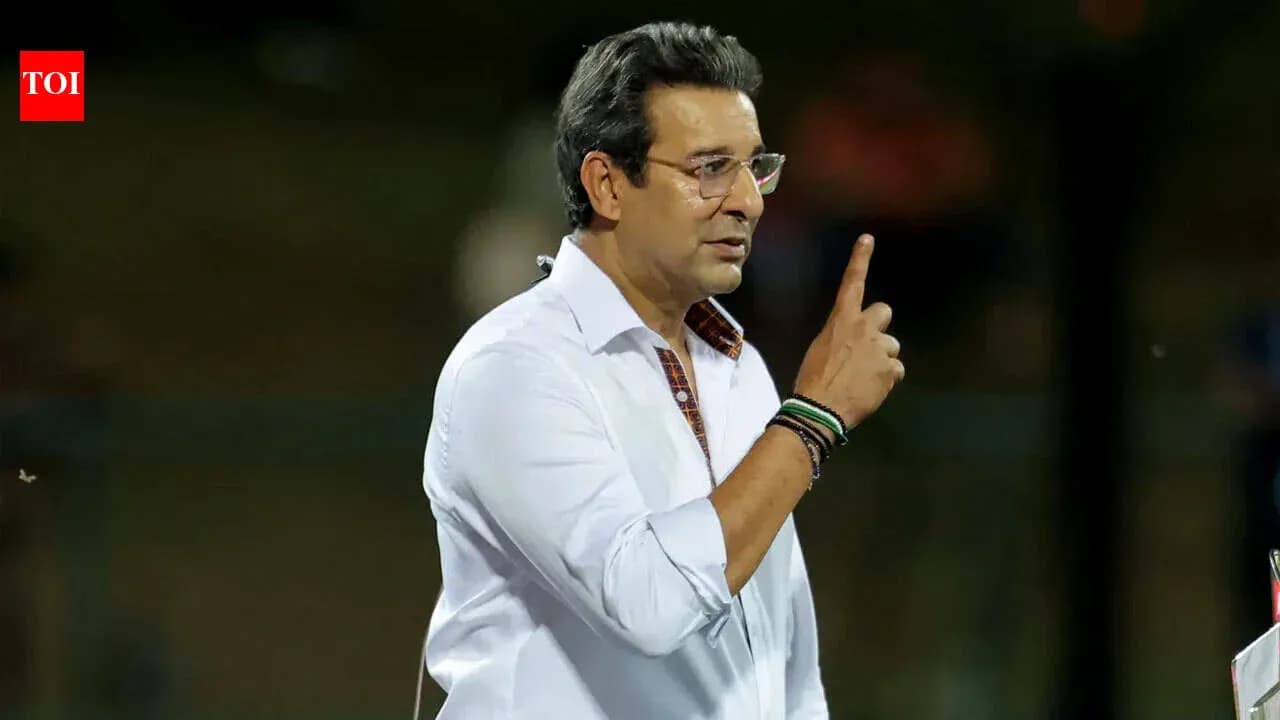
Wasim Akram on India-Pakistan Rivalry: It's Just a Game
Wasim Akram has lived the India–Pakistan rivalry from the middle of the pitch, with a new ball in his hand and 90,000 people howling around him. He has seen tempers flare, careers made, hearts broken. And yet, as the noise around every modern encounter spills into an endless social-media slugfest, the Pakistan great has a blunt message for both sides.
Calm down. It’s cricket. Nothing more.
Speaking on the 1 Mint podcast, Akram urged fans in India and Pakistan to stop dragging the weight of history and politics into a sport he insists should be treated as exactly that — a sport.
“People have too much time. Why can’t they understand? It’s only a frikkin game. At the end of the day, it’s just a match. Somebody has to win, somebody has to lose. And move on to the next one,” he said.
The line is classic Akram: sharp, unsentimental, and delivered with the authority of a man who has lived through some of the fiercest chapters of this rivalry. Yet it lands in a very modern context, where India–Pakistan contests are fought twice — once on the field, and then again, often more viciously, online.
‘Revenge and all is so 1970’
Akram did not sugar-coat his view of the way old wounds and new platforms have fused into something uglier than anything he saw in his playing days.
“What happened many moons ago still lingers,” he said. “Revenge and all is so 1970. It’s the classic ‘an empty mind is a devil’s workshop’ thought process.”
Every India–Pakistan fixture now triggers a familiar cycle: hype, tension, memes, abuse, and days of digital post-mortems. Akram’s point is simple. The game ends. The scorecard is written. Life should move on.
For him, the basic rule of sport remains untouched, no matter the flags in the stands: one team wins, the other loses, and both prepare for the next challenge. The rest, he suggests, is noise fans choose to carry long after the players have walked off.
A young Irfan Pathan, an old master, and a shared craft
Away from the tribalism, Akram also turned the clock back to a more personal story — his first meeting with Irfan Pathan, the Indian left-armer who grew up idolising Pakistan’s great fast bowlers.
“Irfan met me in 2004 on his first tour to Australia; I was commentating. He was a big fan. Grew up watching us. I gave him a few tips here and there, but he did well early on in his career,” Akram recalled.
Pathan’s action, smooth and side-on, always drew comparisons with Akram’s. The Pakistani legend explained that when young quicks approached him, the conversation rarely centred on ripping up their technique.
“His action was similar to mine from the very beginning. But when players ask you about something, what you tell them is mostly about the mindset,” Akram said. “Action and all is fine, because at that stage, you have reached that level where you’re representing the country.”
The lessons he offered were the finer details that separate fast bowlers from fast thinkers: wrist position, reading a batsman, choosing the right moment for a variation, knowing when not to get clever.
“Things like wrist position and how to suss out a batsman. When to use variations, when not to. So yeah, it was good fun. Irfan is a good boy; he still keeps meeting me,” he added.
Those quiet exchanges between a Pakistani great and a young Indian quick cut through the narrative of hostility that often dominates this rivalry. On the field, they were destined to stand on opposite sides. In the craft of fast bowling, they spoke the same language.
Pathan’s Pakistan chapter
Pathan did more than just follow in Akram’s footsteps stylistically. He built a formidable record against Pakistan that ensured his name would always be tied to this fixture.
Across formats, he claimed 67 wickets in 36 internationals against them — 27 in Tests, 34 in ODIs and six in T20Is. The standout memory sits in Karachi, 2006. New ball in hand, green pitch, high stakes.
In the very first over of the Test, Pathan ripped through Pakistan’s top order, removing Salman Butt, Younis Khan and Mohammad Yousuf to claim a hat-trick. He became only the second Indian to take a Test hat-trick, and he did it in the cauldron of an India–Pakistan Test away from home. That spell, brutal and brilliant, still lives in highlight reels and bar-room debates.
His ability to swing the new ball and extract movement made the Akram comparisons inevitable. Over time, his batting turned him into a genuine all-rounder, but it was that early, hooping inswing against Pakistan that defined his aura.
From dressing room to debate stage
Since retirement, Pathan has reinvented himself as one of the more outspoken Indian voices in television studios and on social media. He does not shy away from strong opinions, especially when it comes to India–Pakistan clashes, and has occasionally taken aim at Pakistan and its cricketers in the aftermath of big games.
Akram, though, chose to treat that with a mix of humour and realism.
“It’s a different thing that he keeps tweeting some or the other thing against Pakistan,” he said, with a laugh. “But our fans are ready too. They don’t have the tendency to ignore either. They just have to reply.”
That, in a nutshell, is the cycle Akram wants to break. A pointed comment from a former player, a wave of replies, a fresh round of outrage. None of it changes the result. None of it swings a ball or middles a shot.
For the former Pakistan captain, the line between contest and conflict must stay bright.
“Somebody has to win, somebody has to lose. And move on to the next one,” he repeated.
The rivalry will not soften. The stakes will not shrink. But if a man who has lived its fiercest moments can call it “only a frikkin game,” how long before the fans start to listen?