Will Jacks Stars as England Defeats Sri Lanka in ODI Opener
England did not just win; they imposed themselves. An 89‑run victory over Sri Lanka at Chester-le-Street set the tone for the ODI series, and at the heart of it all was Will Jacks, who turned a solid day into a career-defining one.
Brook leads, Root crosses a giant landmark
Put in after winning the toss, England’s innings never quite became a runaway train, but it had enough steel and enough moments of class to reach 265 before they were bowled out in the 49th over.
Harry Brook, captaining and anchoring, played the central role. His 67 from 69 balls was busy, controlled and increasingly authoritative. He managed the tempo, picked gaps, and kept England from drifting when wickets threatened to stall the innings.
Around him, the familiar figure of Joe Root quietly made history. His 44 was not the flashiest knock he will ever play, but it pushed him past 23,000 international runs across formats – a staggering milestone folded into a workmanlike, important contribution. Root’s presence at No. 3 steadied England just when Sri Lanka’s seamers sniffed an opening.
Ben Duckett’s 32 up top gave England an early platform, while Jos Buttler’s 31 in the middle order hinted at something more explosive without ever quite catching fire. The total, as England walked off, felt competitive rather than imposing.
Then came Jacks.
Sent in with the innings in a delicate phase, he refused to let it meander. His unbeaten 46 from 47 balls was all about clarity: clean strokes, sharp running, and a refusal to let Sri Lanka settle into a late-overs squeeze. When wickets fell around him, he held his nerve and dragged England from “maybe a bit light” to “this could be enough.”
Sri Lanka’s bowlers keep England honest
Sri Lanka’s attack never went away. Every bowler used by the visitors took a wicket, a testament to their persistence and discipline on a surface that offered just enough.
On debut, legspinner Sachindu Colombage was the standout. His 3 for 44 was full of promise: sharp turn, clever changes of pace, and the confidence to challenge England’s batters in the middle overs. Asitha Fernando matched him for incision with 3 for 53, hitting the pitch hard and finding movement to keep England in check.
Dilshan Madushanka, Dushmantha Chameera and Dunith Wellalage each chipped in with a wicket, collectively ensuring England never had the freedom to bat out their 50 overs. They dragged the innings back every time it threatened to surge, and when the last wicket fell at 265, Sri Lanka walked off knowing they had done enough to give their batters a genuine chase.
They just needed partnerships.
A chase that never quite arrived
The reply began with promise. Pathum Nissanka, as he so often does, looked composed and controlled at the top. His 27 from 37 balls was enough to carry him past 3,000 ODI runs – a notable landmark for a player increasingly central to Sri Lanka’s white-ball plans.
At 84 for 2 in the 20th over, Sri Lanka were in the contest. The pitch had settled, the asking rate was manageable, and England needed something special.
They got it.
England’s bowlers tightened the screws. Dot balls started to pile up, strokes that had earlier found the rope now found fielders, and the chase began to fray. Kusal Mendis tried to hold the middle order together with a composed 42, but he kept losing partners as England’s attack hunted in packs.
Then Jacks took over.
Jacks rips through the chase
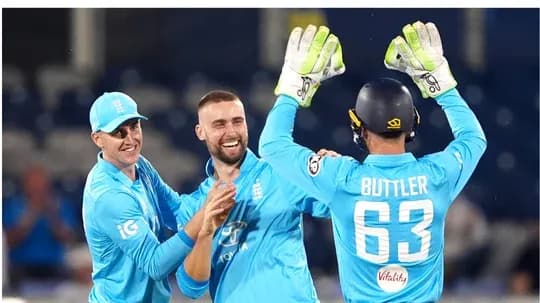
The offspinner’s spell was everything England could have asked for. He was relentless, attacking the stumps, using the angles, and forcing mistakes. Sri Lanka’s middle and lower order had no escape route.
Seven overs. Five wickets. Just 22 runs.
Jacks’ maiden ODI five‑for was not about mystery or drama; it was about accuracy, pressure, and a ruthless sense of timing. Each breakthrough cut deeper into Sri Lanka’s hopes, each wicket tightening England’s grip.
Jamie Overton played his part with two crucial strikes in quick succession that triggered the late collapse, ripping out what remained of Sri Lanka’s resistance and leaving the lower order exposed to Jacks’ control.
Only Dunith Wellalage dared to hit back. Coming in with the game slipping away, he counterpunched bravely, cracking 45 from 36 balls. It was a spirited, fearless cameo that briefly forced England to think again, as he cleared the field and refused to simply fold.
But he was fighting a lone battle. Wickets kept tumbling around him, the required rate spiked, and the scoreboard pressure finally crushed Sri Lanka’s chase. All out for 176 in 37 overs, they finished a long way short of the target and even further from the position they had held at 84 for 2.
Statement win, statement performance
By the time the players shook hands, there was no debate about the Player of the Match. Jacks had shaped the game twice: first with the bat, then with a spell of bowling that turned a contest into a procession.
England walk away from Chester-le-Street with a 1–0 lead and a template that will please them: runs spread through the order, a captain’s innings from Brook, a landmark for Root, and a bowling unit capable of sustained, suffocating pressure.
Sri Lanka leave with flashes of encouragement – Colombage’s debut, Nissanka’s milestone, Wellalage’s fight – but also with a blunt reminder. Against this England side, in these conditions, anything less than sustained discipline with bat and ball will be punished.
The series has its tone now. The question is whether Sri Lanka can change it.