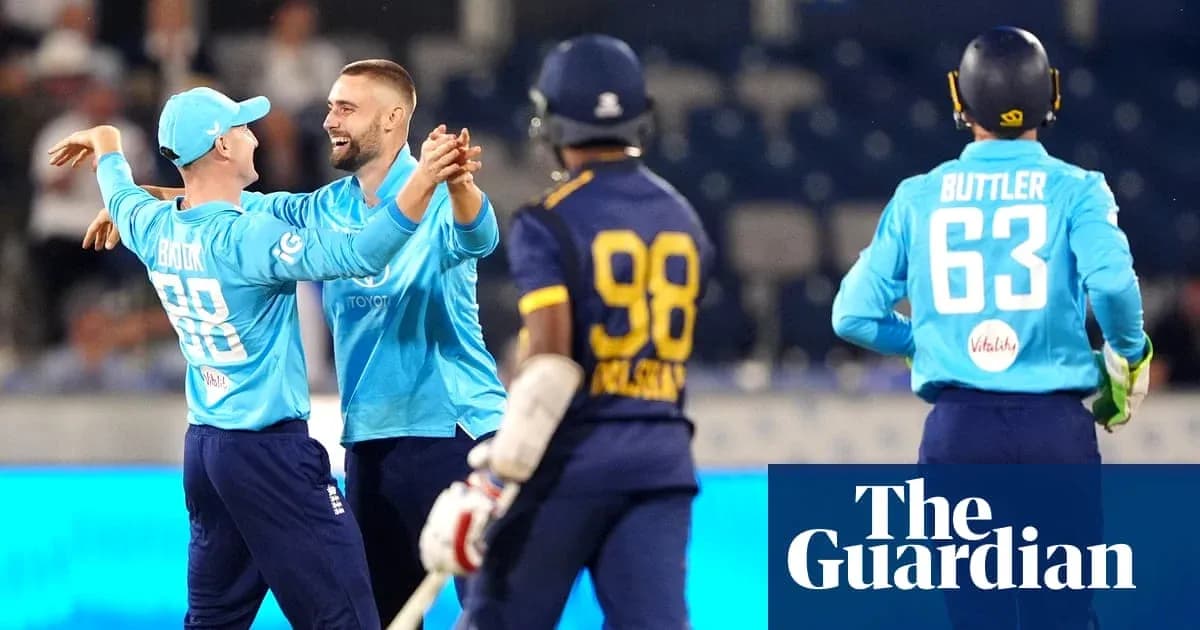
Will Jacks leads England to victory over Sri Lanka
Harry Brook had asked for “high‑octane” cricket. What he got instead at Chester-le-Street was something different: a grind, a scrap, and then, quietly but emphatically, control. England’s ODI revival is not roaring yet, but in this six‑wicket win over Sri Lanka it found a heartbeat – and it sounded a lot like Will Jacks.
On a tired, end-of-season pitch that sucked the life out of strokeplay, England’s 265 all out in 48.1 overs felt light. No sixes, a collapse in the middle, and a debutant wrist-spinner from the East Anglian Premier League making their top order look twitchy. It was a long way from the neck‑craning carnage of the Twenty20 sweep.
Yet Sri Lanka never really looked close. Bowled out for 176, 89 runs short, they were strangled by England’s attack and, above all, by Jacks, whose evolving role as Brook’s vice-captain suddenly looks central to whatever this new ODI side becomes.
Brook steady, Jacks vital
Brook, now into credit as England’s 50-over captain with 11 wins and 10 defeats, played the anchor. His 67 under a warm September sun was the innings around which England tried to build something larger. They never quite did.
At 182 for three, with Brook set and Joe Root already banked for 44, 300 looked within reach. Then the innings stalled. Brook, who had looked almost immovable, went searching for one big release shot, charging Dushmantha Chameera for one of his trademark inside-out swipes. Instead he sliced to deep point. The air went out of England’s innings with him.
From there, 182 for three became 211 for seven in 46 balls. Four wickets for 29 runs. Buttler, who had scratched his way to 31, was trapped lbw by Sachindu Colombage. Rehan Ahmed ran himself out in a moment that would have had Kevin Pietersen – drafted in as England’s new mentor and vocal about the need for sharper strike rotation – shaking his head. Ahmed set off, realised there was never a single, and almost surrendered to the inevitable.
Through it all, Jacks watched, waiting, then acted. Coming in down the order, a role he has had to learn after years preferring the top three, he supplied the late punch England desperately needed. His unbeaten 46, including 18 crucial runs off the 48th over, dragged the total from fragile to defendable.
Since being moved into this lower middle-order brief last year, Jacks has quietly turned himself into a serious ODI option: averaging 43 and scoring at better than a run a ball. On this surface, with the innings unravelling, that mattered more than ever.
Colombage’s moment, Root’s streak ends
If Jacks was the day’s defining figure, Colombage provided its surprise. Plucked from relative obscurity – last summer he was turning out for Downham Stow in the East Anglian Premier League – the 28-year-old wrist-spinner gave Sri Lanka a rare bright note.
His action is jerky, his approach a little ungainly, but the ball drifted, dipped and then bit. The numbers said unremarkable; Gary Kirsten, Sri Lanka’s head coach, chose to trust his eyes instead. He was rewarded with three for 44 and a spell that disrupted England’s rhythm.
Root, who had gone 416 balls in ODI cricket without being dismissed – a run of 404 runs stretching back to England’s 2-1 win in Sri Lanka last winter – saw his off stump rattled as he played back to one that skidded through. Buttler followed, pinned on the crease. Jamie Overton, later, was beaten by a leg-break that climbed above his eyeline and ripped sharply back.
By the end of the innings, England had gone through 50 overs of ODI batting without clearing the rope for the first time in more than seven years. On a flat August road that would have been a crisis. On this late-September surface, it was more a reflection of conditions – and of how well Sri Lanka’s spinners, led by Colombage, had adapted.
WinViz had Sri Lanka as slight favourites at the interval. Anyone who had watched the ball grip and hold, though, knew England had more than the algorithm suggested.
Spin takes over as Sri Lanka fold
From the moment Sri Lanka began their chase, England’s bowlers looked like they knew exactly what they had. The seamers probed, the pitch offered enough, and the tourists never truly escaped the squeeze.
Jofra Archer, at the end of his all-format summer, took some punishment late on but the damage was already done. Jamie Overton, banging in cross-seamers, picked up two wickets and kept Sri Lanka honest. The absence of Adil Rashid, ruled out of the series with a hand injury, might have been a glaring hole. Jacks made sure it wasn’t.
Given the ball as Brook hunted control rather than fireworks, Jacks dismantled Sri Lanka with a spell that underlined why his captain talks about him as far more than a “part-timer”. Seven overs, five for 22. Drift, dip, changes of pace, angles that dragged batters into mistakes.
He removed Dunith Wellalage, Sri Lanka’s top-scorer with 45, and kept coming. Every time the tourists looked like they might string a partnership together, Jacks cut it off. His figures are now the second-best by an England spinner in ODI history, behind only Vic Marks’s five for 20 against New Zealand in Wellington in 1984.
Brook’s praise afterwards matched the performance. Jacks, he said, “is not a part-timer, he’s a very good off-spinner. He can spin the ball big and contain. He could have moaned and groaned about playing as an all-rounder but he’s accepted that and become a very vital player for us over the past 18 months. He’s a very good leader, with bat, ball and in the field.”
The final act belonged to him too. With Sri Lanka already beaten, he finished the job with a ripping delivery that went through No 11 Dilshan Madushanka, sealing his first five-wicket haul and England’s 1-0 lead in the series.
A quiet resurgence with louder tests to come
This was not a night of wild innovation or deep revelation. Chester-le-Street in late September rarely is. England defended a sub‑300 total for the first time since 2022, leaned on conditions they knew well, and saw their captain edge further into the black in this format.
What mattered more was the shape of the win. Brook, steady and increasingly sure as a 50-over leader. Root still churning runs, even as his remarkable streak ended. A new spinner in Colombage asking questions of established names. And Jacks, the all-rounder who didn’t sulk about batting lower, instead taking ownership of the game with both bat and ball.
The volume of England’s ODI cricket will have to rise over the next 12 months as the next World Cup cycle looms. If this was a slow burn rather than a blaze, it still felt like a step: a side learning how to win ugly again, on tricky pitches, without six-hitting pyrotechnics.
On Thursday at Headingley, Brook will want the tempo higher. The real question is whether this evolving team, with Jacks now firmly at its core, can turn these flickers into something that truly catches fire.